
Most security content describes the threats of the moment. This article is about the ones arriving next — the risks that analysts, insurers, and security researchers broadly agree are moving from the enterprise conversation into everyday business reality over the next few years. For an owner, the useful question about each is not "is this frightening?" but "does this require action now, or attention later?" We have sorted them accordingly.
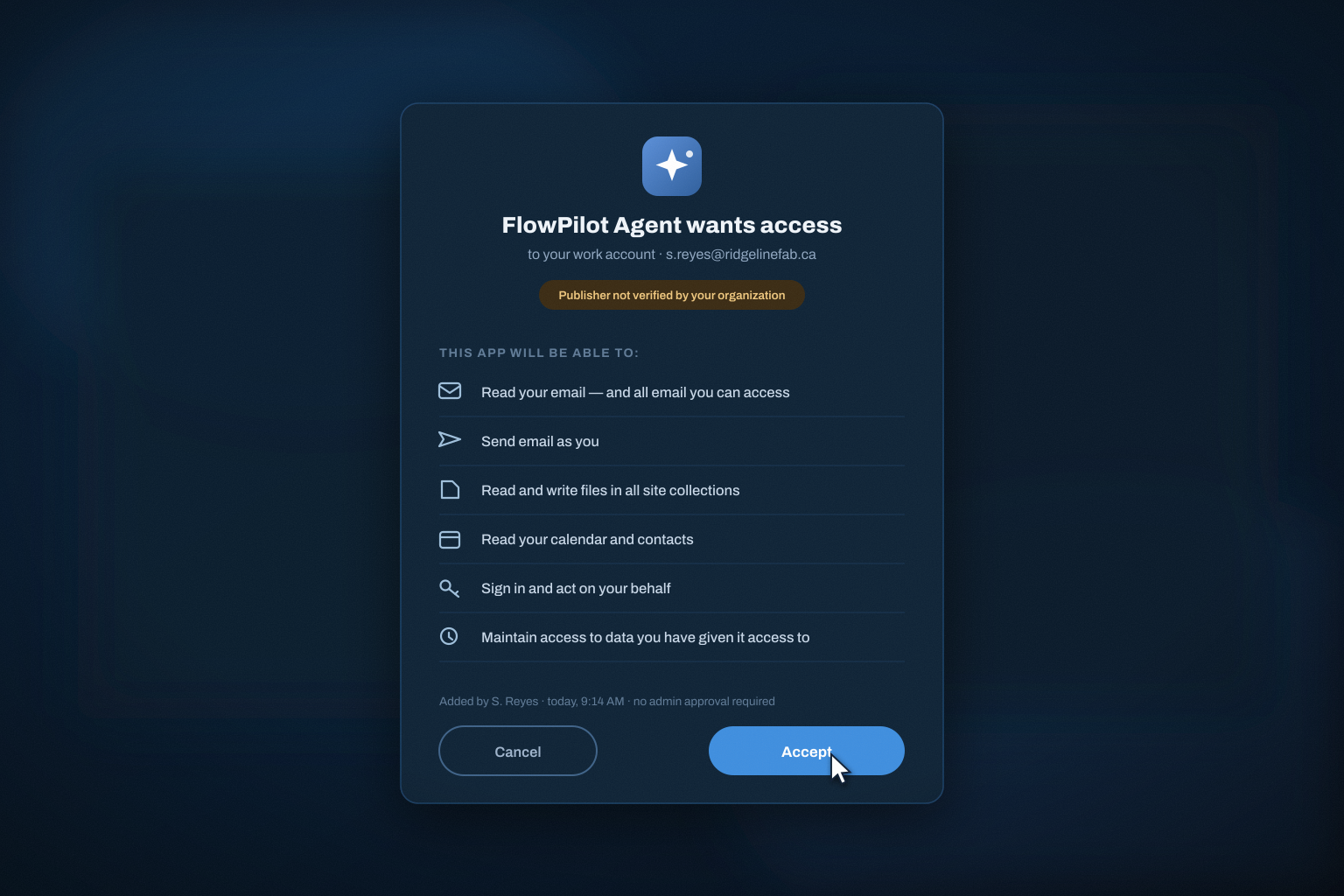
The defining shift of this period is AI that no longer just answers questions but takes actions: reading mailboxes, updating records, moving files, sending messages, and completing multi-step tasks on its own. Vendors are embedding these "agentic" capabilities into the platforms businesses already use, and staff are connecting them to company accounts — often through low-code tools, and often without anyone approving it.
An AI agent is, functionally, a new kind of employee: one that works at machine speed, follows instructions literally, never gets suspicious, and can be manipulated by cleverly crafted content it reads. That last point deserves emphasis — attackers have learned to plant instructions inside emails, documents, and web pages that an agent will process, effectively social-engineering the software instead of the person. An agent with broad access to a mailbox or file system is a powerful assistant and, mis-instructed, a powerful liability.
Act now. The controls are extensions of things covered elsewhere on this blog: an inventory of what AI tools and agents are connected to company accounts (the shadow AI problem, now with hands), least-privilege access for any agent (it gets the access its task needs, never an administrator's), a named human owner for every agent, and approval requirements for consequential actions like sending payments or external messages. Businesses that cleaned up permissions for Copilot have a head start; agents inherit the same lesson — the AI can act on whatever it can reach.
Behind the scenes of an ordinary business there are already more non-human accounts than human ones — service accounts, API keys, and integration credentials connecting systems together. Agents accelerate this sharply, and these identities are historically the worst-managed in any environment: shared, never rotated, excluded from MFA, and untouched at offboarding. Analysts consistently identify machine identity management as a coming pain point precisely because attackers already prefer these accounts.
Act now, modestly. This does not require enterprise tooling at small-business scale. It requires the machine accounts appearing on the same access list your provider maintains for people — what exists, what each can reach, who owns it, and when its credentials last changed — and the offboarding checklist asking, for every departure, "what integrations did this person set up?"
The same agentic capability is being adopted on the other side. Security researchers are documenting AI-assisted attacks that scan for vulnerabilities, craft personalized phishing, and adapt mid-campaign with little human involvement — meaning the interval between a weakness appearing and being exploited keeps shrinking, and the volume of convincing, individually tailored lures keeps growing. For a small business, the practical meaning is blunt: "too small to be worth attacking" is obsolete when the attacker's marginal cost per target approaches zero.
Act now — but this changes priorities, not fundamentals. Machine-speed attacks reward the businesses whose patching is prompt, whose MFA is phishing-resistant, and whose monitoring responds around the clock rather than during office hours. The controls are familiar; the tolerance for doing them slowly is what disappears.
Quantum computing capable of breaking today's common encryption does not exist yet, and estimates of its arrival span years. The risk that exists today is preparatory: well-resourced actors are believed to be collecting encrypted data now, to decrypt when the capability matures. The industry response — post-quantum cryptography — is already being built into the platforms and browsers businesses use, and governments have published migration timelines extending into the early 2030s.
Watch, with one question. For most small businesses this transition will arrive through vendors updating their products, not through projects of your own. The owner-level action is a single question in your annual review: which of our data would still be damaging if exposed in ten years — long-term contracts, IP, health or financial records — and are the systems holding it on a vendor's post-quantum roadmap? Businesses selling to government or critical infrastructure should expect the question to appear in procurement first.
The quieter trend behind all of the above: rules are following the technology. AI governance expectations, expanding privacy obligations, and security requirements flowing through insurance policies and client contracts are all tightening, and — as we've covered in our Canadian-focused articles — the questionnaire from your insurer or your biggest client tends to arrive before the statute does. The businesses that keep documented evidence of their controls answer these cheaply; the rest scramble annually.
The pattern across every emerging risk is the same one this blog keeps returning to: the businesses that will handle the next five years well are the ones that can answer, at any moment, what is connected to their systems, what each thing can reach, and who is watching. The technology changes; the question doesn't.
Superion helps BC businesses fold emerging risks into a practical technology strategy — what to act on, what to watch, and what to decline to panic about. Contact us to put the triage above on your calendar.
Head Office
101 – 17618 58th Ave,
Surrey BC V3S 1L3 Canada
Monday to Friday
Office: 08:30AM to 05:00PM (PDT)
Help Desk: 04:00AM to 05:30PM (PDT)
