
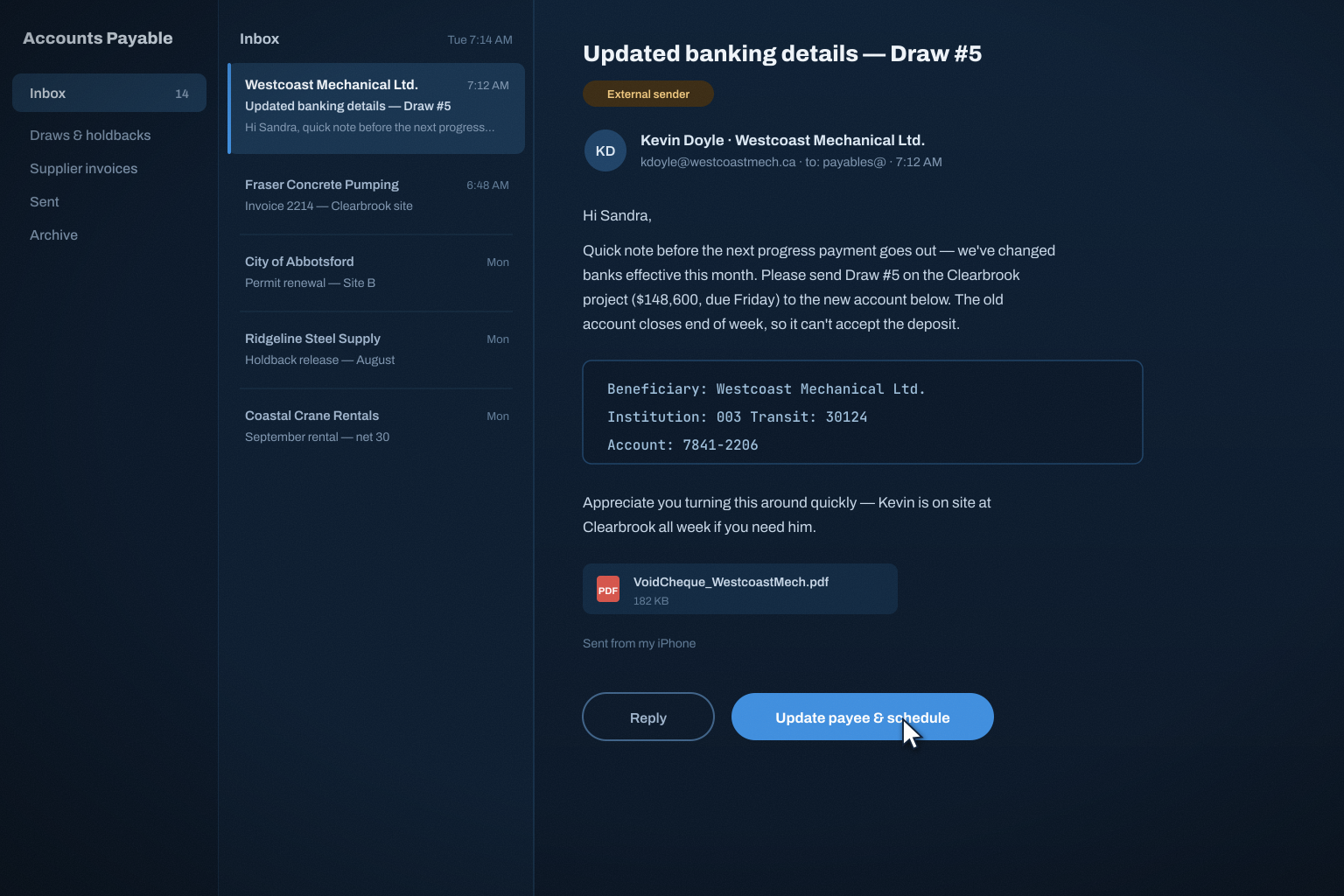
Fraudsters study industries the way sales teams do, and construction has features they prize: large progress payments on predictable schedules, long chains of subcontractors and suppliers invoicing each other, project details published openly on permits and site signage, and payment decisions made quickly by busy people. It is no accident that construction consistently ranks among the sectors most targeted by payment fraud in Canada.
The attacks are not sophisticated in the Hollywood sense. They are patient, well-researched imitations of your industry's ordinary paperwork.
The banking-change letter. Your accounts payable receives an email, apparently from a subcontractor you genuinely owe, advising that their banking details have changed and asking that the next progress payment go to the new account. The email may come from the sub's real address — their mailbox having been quietly compromised — and reference the correct project, contract value, and draw schedule. The payment leaves; the real sub calls three weeks later asking where their money is; and the funds are long gone. Both companies then spend months arguing about who bears the loss.
The impersonated GC or owner. The scheme runs in the other direction too: your subs and suppliers receive convincing emails, apparently from your project accountant, redirecting their payments or requesting deposit changes. Your company's name becomes the instrument of fraud against your own trade partners, with the relationship damage landing on you.
The urgent executive request. Site supervisors and project accountants receive messages, apparently from the owner or CFO, requesting an urgent transfer for equipment, permits, or a deal that cannot wait. With AI voice cloning, the follow-up phone call now sounds exactly like the boss — a development we examine in our article on deepfake fraud.
Several habits common in the industry work in the fraudster's favour. Payment approvals frequently ride on email alone, because everyone is in the field. Project managers, estimators, and site staff share logins to project management and drawing platforms, so a single phished password opens everything and can never be traced to a person. Site trailers run on consumer-grade internet with no business protections. And the tempo of the work — draws to make, holdbacks to release, deficiencies to clear — rewards fast approval, which is precisely the behaviour the fraud is engineered to exploit.
Ask your accounts payable person one question: "If we got an email today from our biggest sub saying their bank account changed, what exactly would you do?" If the answer is anything other than a description of your written verification procedure, the procedure does not exist yet — and it is the highest-return afternoon of work available to your company.
Superion supports construction and trades businesses across Canada— office, site, and everything between — through managed cybersecurity and IT services built around how contractors actually work. Contact us to review where your payment workflow is exposed.
Head Office
101 – 17618 58th Ave,
Surrey BC V3S 1L3 Canada
Monday to Friday
Office: 08:30AM to 05:00PM (PDT)
Help Desk: 04:00AM to 05:30PM (PDT)
