
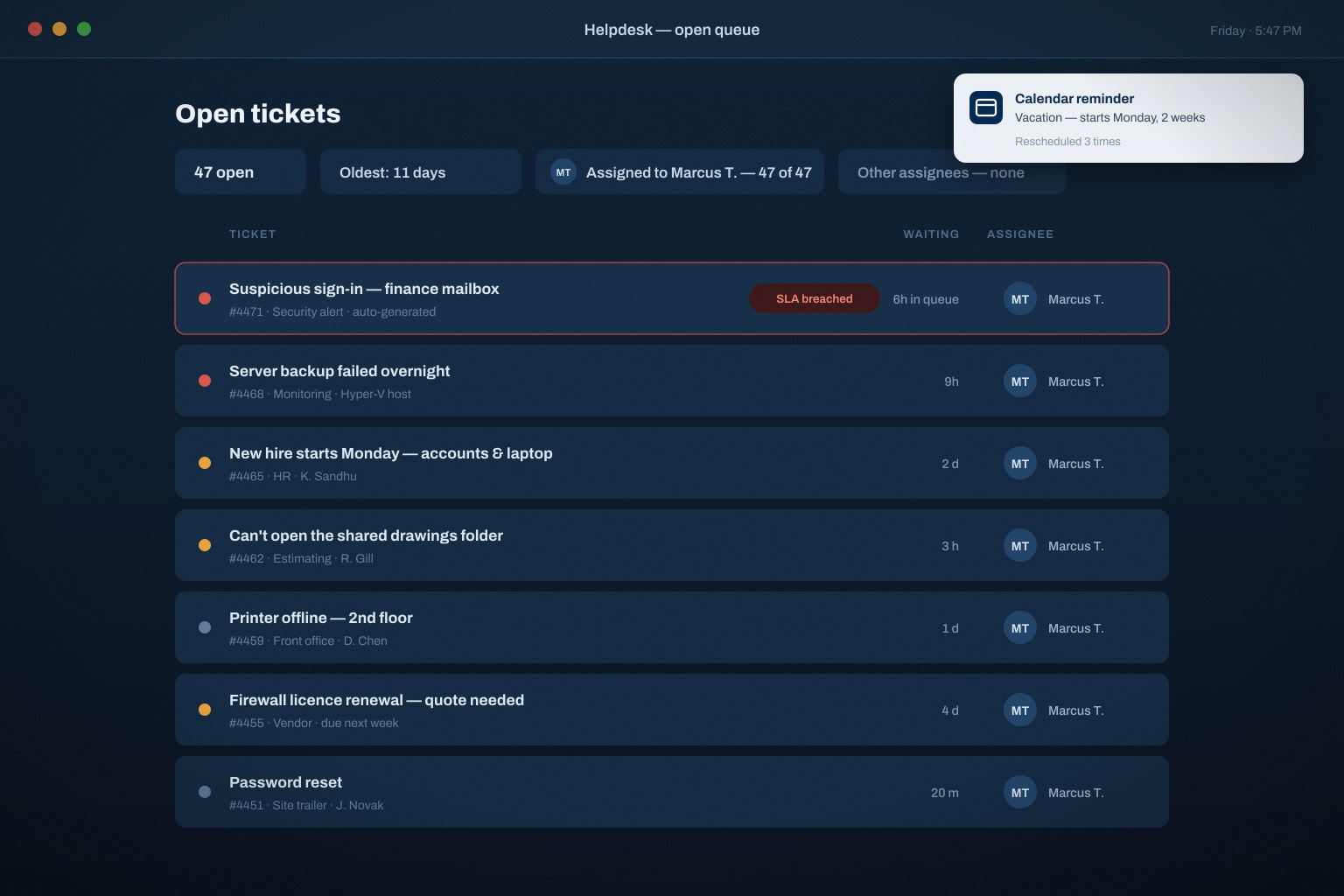
The IT support conversation is usually framed as a choice: hire internally or outsource to a managed provider. We've compared those models before, and for smaller businesses the choice is real. But for companies in the 30-to-200 employee range, the framing itself is often wrong. Many of them already have an internal IT person or small team who knows the business deeply — and who is drowning anyway.
The pattern is consistent. One or two capable people carry help desk requests, server maintenance, security, projects, vendor management, and the expectation of being reachable on vacation. Strategic work is perpetually displaced by whoever is standing at their desk. Nights and weekends are uncovered. Specialized needs — a security investigation, a complex migration, a compliance questionnaire — exceed what any individual can be expert in. And the company is one resignation away from the crisis we've written about elsewhere as key-person risk.
Co-managed IT exists for exactly this situation: your internal staff remain, and a managed provider works alongside them, supplying the tooling, depth, and coverage that a small internal team cannot economically build alone.
There is no single template — the point of the model is that the split is designed around your team — but the common arrangements share a logic: the internal staff keep what benefits from being inside the business, and the provider takes what benefits from scale.
Two additions deserve particular mention because internal teams rarely have them. First, enterprise-grade tooling: the monitoring, security, and documentation platforms a provider spreads across its whole client base are prohibitively expensive for one company to licence for one technician. Second, vacation. Under co-management, your IT manager can be genuinely unreachable for two weeks, which — ask them — may be the benefit they value most.
Handled properly, it is not a prelude to replacing your staff, and any provider who treats it that way should be shown the door. The internal person's role typically moves up, not out: less password-reset traffic, more of the projects and vendor strategy the company actually hired them to think about. It is also not a licence for blurred accountability. The failure mode of co-management is the ticket both sides assumed the other owned, which is why the arrangement lives or dies on a written responsibility matrix: for every category of work, who acts, who is informed, and who is accountable.
Co-management earns its keep where there is a genuine internal role to preserve: enough staff, sites, or operational complexity that having IT judgment inside the building matters daily. Below roughly thirty seats, a fully managed arrangement is usually simpler and better value. And where an internal team is large and well-resourced, targeted project help may be all that's needed. The model's sweet spot is the company in between — big enough that one or two IT people are essential, not big enough that they can be everything.
Ask your IT person three questions: What are you not getting to? What happens when you're away? And what would you hand off tomorrow if you could? If the answers are a list, a wince, and another list, the constraint on your IT isn't the person. It's the model.
Superion provides co-managed IT across BC — your team, our depth, one documented picture of the environment. Contact us to design the responsibility split around the people you already have.
Head Office
101 – 17618 58th Ave,
Surrey BC V3S 1L3 Canada
Monday to Friday
Office: 08:30AM to 05:00PM (PDT)
Help Desk: 04:00AM to 05:30PM (PDT)
