
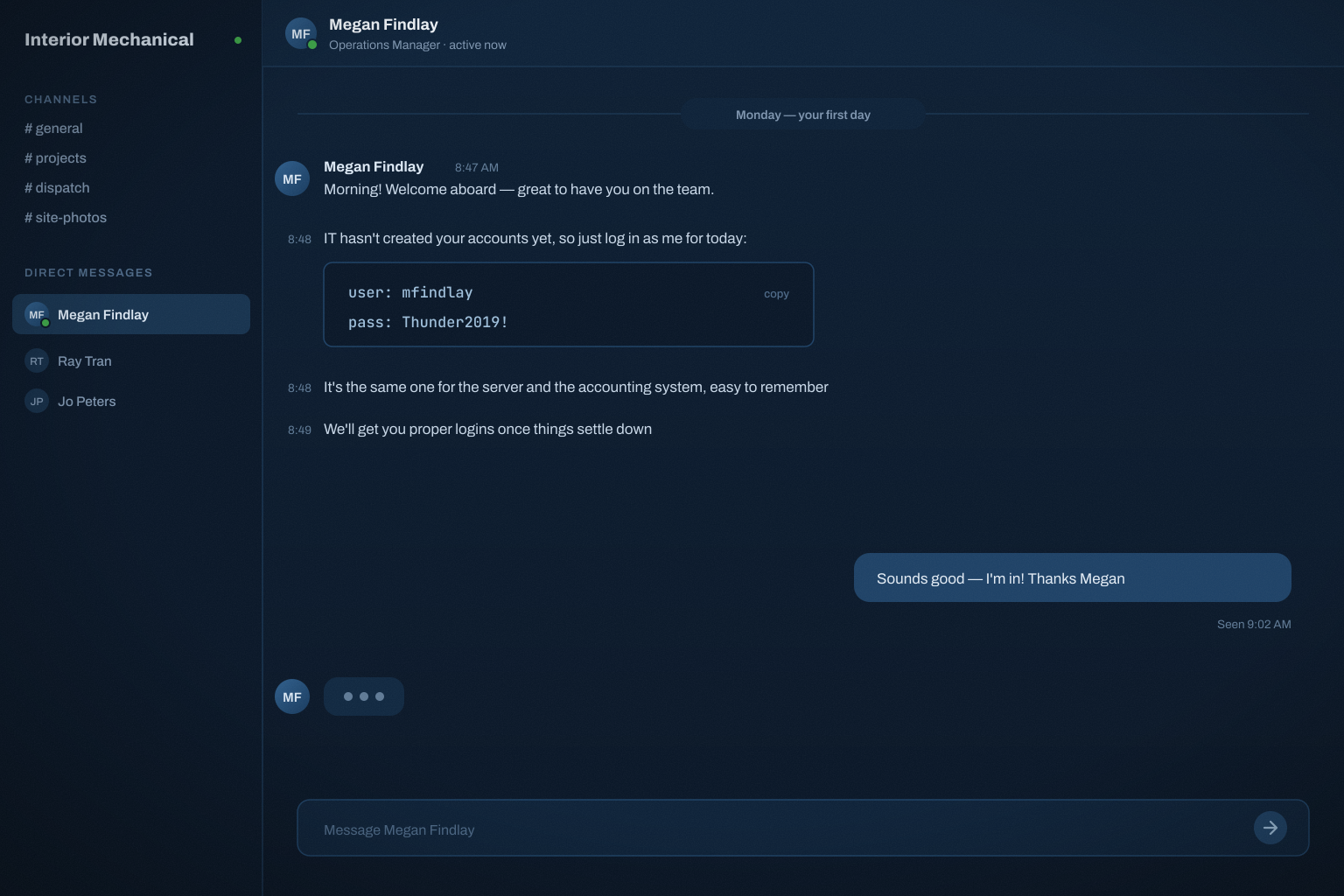
Most businesses experience new-hire IT in one of two ways. In the first, the employee arrives to a configured computer, working accounts, and access to exactly what their role requires, and is productive before lunch. In the second, the employee spends their first days borrowing a colleague's login "just for now," and the business spends the next several years unable to say precisely what that person can access.
The difference is not budget. It is whether onboarding is a process or an improvisation, and the choice has consequences that outlast the first week considerably.
Shared credentials never get unshared. The password lent on day one becomes permanent knowledge. Multiply this across years of hires and the honest answer to "who knows this password?" becomes "we don't know," which means every departure should trigger a rotation that, in practice, never happens.
Copied access compounds. The fastest way to set up a new hire is to duplicate a colleague's permissions. But that colleague's access reflects their entire history — old projects, former roles, exceptions granted and forgotten. Copy it a few times and the connection between role and access dissolves. This accumulation, called privilege creep, is why a routine audit so often finds junior staff able to open executive folders: no one decided it; it was inherited.
Excess access magnifies every incident. When an account is eventually phished, the damage is bounded by what that account could reach. Access granted generously on day one, and never reviewed, is the difference between a contained incident and a comprehensive one.
Day one sets the culture. An employee whose introduction to the company includes a shared password learns that security here is negotiable. One who receives their own credentials, MFA enrollment, and ten minutes on how the company handles suspicious email learns the opposite. Both lessons persist.
Every grant of access made during onboarding should be recorded: which systems, what level, approved by whom. This log is modest effort in the moment and invaluable later — it is the difference between offboarding as a checklist reversal and offboarding as archaeology. The two processes are mirrors: a departure can only be as clean as the arrival was documented.
Pick any employee hired in the past year and ask for the list of systems they can access and who approved each. If the list can be produced in minutes, your onboarding is a process. If producing it would require an investigation, every hire since has been quietly adding to a debt that comes due at the worst possible times: during an audit, an insurance application, an incident, or a difficult departure.
Superion runs standardized onboarding and offboarding for client teams as part of managed IT services: role-based access, documented grants, and day-one readiness as the default. Contact us to make your next hire the clean one.
Head Office
101 – 17618 58th Ave,
Surrey BC V3S 1L3 Canada
Monday to Friday
Office: 08:30AM to 05:00PM (PDT)
Help Desk: 04:00AM to 05:30PM (PDT)
